

 English
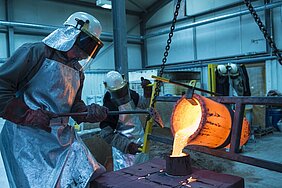
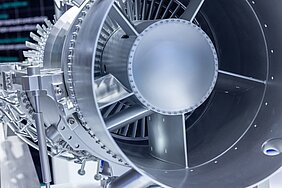
The process offers important advantages for industries such as aerospace, medical technology, automotive engineering, and jewelry manufacturing.
- Investment casting enables complex geometries with high detail fidelity through the use of wax patterns and ceramic molds. As a result, post-processing effort can often be reduced significantly for near-net-shape components.
- The process is suitable for a wide range of metal materials and, with proper process control, can achieve good dimensional accuracy. This can reduce machining steps and improve the cost-efficiency of complex components.
- It is widely used whenever precision and surface quality are critical. The method is especially relevant for components with complex shapes and high quality requirements.
What Is Investment Casting and How Does It Work?
Investment casting is a manufacturing process in which a metal part is produced from a disposable wax model and a ceramic mold. First, wax patterns are created as exact replicas of the desired part geometry. These patterns are repeatedly dipped into ceramic slurry and coated with refractory material to build a hard ceramic shell.
Once the shell has cured, the wax is melted out carefully, leaving a hollow mold cavity with the exact shape of the future component.
In the next step, molten metal is poured into the empty ceramic shell, completely filling the cavity and forming an exact replica of the original wax pattern.
After cooling, the shell is broken away and the finished metal part is removed. This sequence makes the process particularly suitable for complex shapes and high-quality surfaces.
Why Is This Process Ideal for Complex Geometries?
The method is ideal for complex geometries because it can reproduce very fine details accurately and reliably.
Since the mold is created around a disposable model, there is no need for conventional mold parting in the same way as in other manufacturing processes.
This precision is made possible by the principles of lost wax casting, which allow engineers to create sharp edges, intricate internal features, and organic forms.
That flexibility is highly valuable across many industries. Components can often be produced close to the final contour, reducing finishing effort and improving manufacturing efficiency.
Advantages and Disadvantages of Investment Casting
One of the main advantages of investment casting is its high dimensional accuracy. This often reduces the need for post-processing and can reduce both lead time and costs.
The method also supports many metal materials, including carbon steels, stainless steels, and special alloys. That makes it suitable for demanding applications with complex part geometries.
- Investment casting offers high precision, supports many metal materials, and can reduce finishing effort for complex components.
- Compared with sand casting and MIM, it often involves higher costs due to more complex tooling, multiple investment casting processes, and longer lead times.
How Does It Differ from MIM, Die Casting, and Sand Casting?
Investment casting is a precision casting process for complex metal components and technically sits between MIM, die casting, and sand casting.
In this method, liquid metal is poured into a ceramic mold based on a lost wax pattern. MIM (Metal Injection Molding), by contrast, uses a feedstock made of metal powder and binder. The part is molded, debound, and then sintered.
Die casting forces liquid metal into a permanent mold under high pressure and is especially suitable for high production volumes with short cycle times.
Sand casting uses sand molds and is particularly relevant for larger components, smaller production runs, and less demanding requirements for surface finish and dimensional accuracy.
This precision casting method is typically selected when complex geometries, good surface quality, and near-net-shape production are required.
MIM offers advantages for very small, delicate parts produced in high volumes, while die casting is especially economical for large series and alloys that are well suited to the process. Sand casting is often the better choice when component size, flexibility, and tooling cost matter more than maximum precision.
Applications of Investment Casting
- In aerospace, investment casting is used for precise turbine components with complex geometries and high quality requirements, including parts such as a turbine blade.
- In medical technology, the process is used for biocompatible implants when precise geometries and reproducible part properties are required.
- In the automotive industry, it enables the economical production of complex engine components with good dimensional accuracy and limited post-processing.
- The jewelry industry also relies on lost wax casting when intricate details and high-quality surfaces must be reproduced precisely.
When Does the Process Reach Its Limits?
This method reaches its limits primarily when very small, delicate metal parts with tight tolerances must be produced in high volumes.
In such cases, MIM may offer advantages because it enables the economical serial production of very small, complex metal parts with high repeatability.
MIM is particularly suitable for precision parts that require tight tolerances, delicate geometries, and minimal post-processing.
Investment casting remains a strong option for complex geometries and many material choices, but it does not achieve the same economic efficiency as MIM in every part category.
PolyMIM supports companies exactly at this decision point when evaluating whether MIM is the technically and economically suitable alternative for a specific application.
FAQ
When Is Investment Casting the Better Choice Than Sand Casting?
Investment casting is usually the better choice when complex geometries, good surface quality, and higher dimensional accuracy are required. Sand casting, on the other hand, is often more suitable when larger components, lower tooling costs, or smaller production volumes are the priority.
When Is MIM the More Suitable Alternative?
MIM is especially suitable for very small, delicate metal parts with high production volumes and tight tolerance requirements. This casting method often remains advantageous when larger geometries, different material options, or more typical casting applications are the main focus.
Which Components Can Be Manufactured Most Economically?
The process is particularly economical for complex near-net-shape metal components that would otherwise require extensive machining or would be difficult to produce using simpler casting methods. This is especially true when precision and reduced post-processing are important.
What Requirements Should a Component Meet?
A component is suitable for this method when complex shapes, fine details, and defined surface finishes are needed with as little machining effort as possible. Suitability also depends on material, part size, tolerances, and production volume.
Why Is Investment Casting Used Despite Higher Process Costs?
It is used because it can produce complex geometries with good surface quality and high detail fidelity. The higher process effort can be worthwhile when it reduces machining steps and enables near-net-shape production of demanding components.